A Postcard from Príncipe Island
“Leve leve,” they say there.
Light, light. Slowly, slowly.
Not as an instruction, but as a way of being.
São Tomé and Príncipe sits quietly in the Gulf of Guinea, forming one of West Africa’s smallest nations. Just above the equator, its geographic coordinates are: 1°N, 7°E.
I arrive on a six-hour direct flight from Lisbon, and short 35-minute hop from São Tomé on a 20-seat propeller plane. Landing on the same time zone, no jet lag, just a gentle sense of having slipped sideways into another rhythm. The kind where time stretches rather than presses.
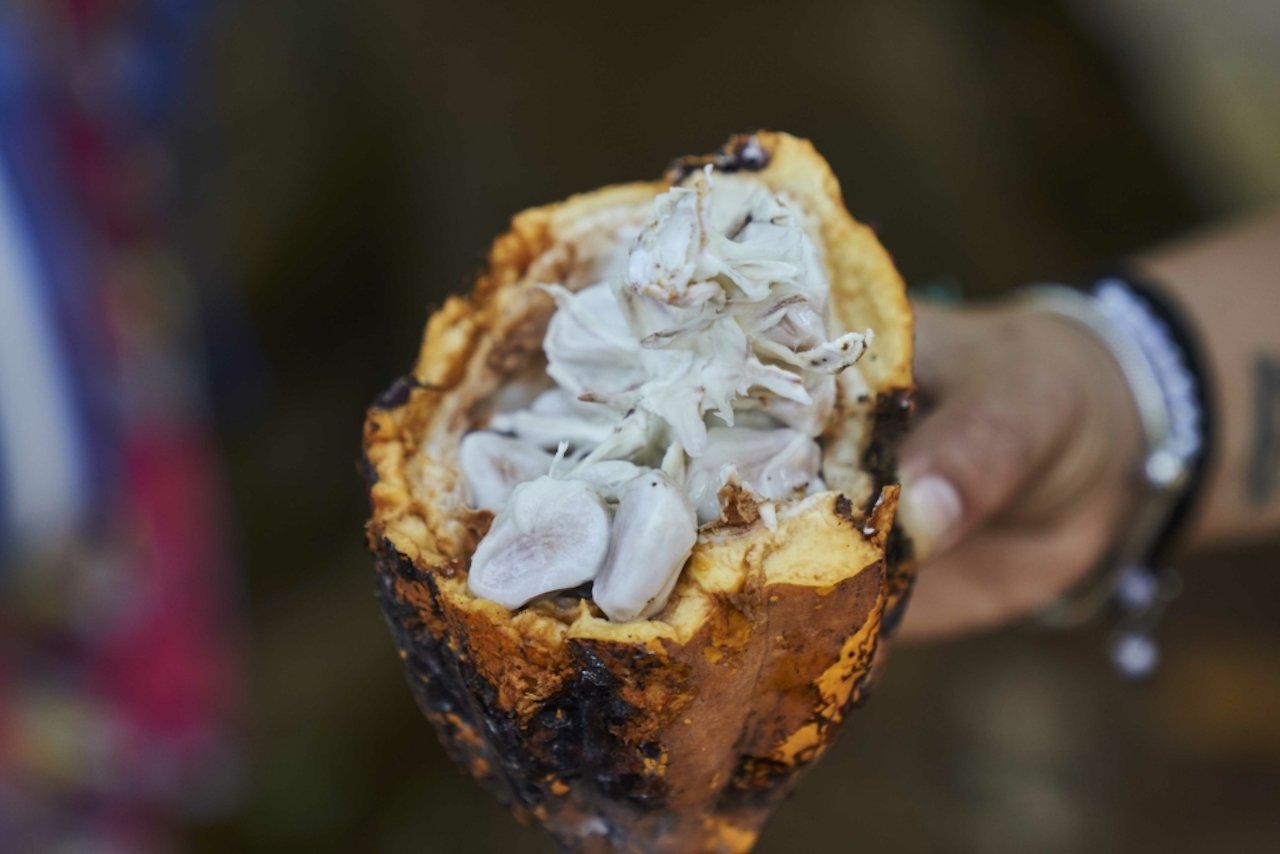
My driver, Osvaldo, meets me at the airport. The road to Praia Sundy is bumpy, red earth rising in clouds, the rainforest closing in on both sides. We stop suddenly. He smiles, cracks open a cacao pod on a rock, and hands it to me.
These are the chocolate islands afterall! The white pulp inside the pod is thick, sticky, almost jelly-like. I chew the first bean politely, hiding my dislike. Osvaldo laughs gently and shows me how: you don’t chew the bean, you suck the pulp off it. And suddenly: sweetness. Tangy, tropical, refreshing. Chocolate, it turns out, begins as fruit.
Where rainforests remember everything
Uninhabited until the late 15th century, Príncipe is now a UNESCO World Biosphere Reserve. More than half the island is protected rainforest, estimated to be over 30 million years old. The canopy is not simply green; it’s a kaleidoscope of mint, jade, olive, emerald and sage. Bright yellow and red cacao pods hang heavy from branches, reminders of centuries of agricultural dominance.
The island’s story today is inseparable from HBD Príncipe or “Here Be Dragons”, founded by Mark Shuttleworth, the first African in space. Looking down at Earth from orbit in 2002, he returned determined to protect it. When a palm oil company threatened to clear-cut Príncipe’s forest, he proposed an alternative: sustainable tourism rooted in conservation and community. The government agreed. And the island chose a different future.
Today, HBD Príncipe operates Sundy Praia, Roça Sundy, Bom Bom, Omali on São Tomé, and soon, the beautifully restored Roça Belo Monte, opening in May 2026.
Sundy Praia: where the rainforest meets the se
I arrive at Sundy Praia, a Small Luxury Hotels property, tucked into the forest edge on the island’s north coast. Fourteen elegant tented villas, barely touching the land. My welcome drink is chilled Erva Príncipe tea with cinnamon. I take bags home, but never quite manage to recreate the magic.
Inside my open plan tented villa, the bathroom area stops me in my tracks. An “Out of Africa” granite bathtub carved by hand, facing the forest. One night, I order room service and sink into a long, contemplative bath, listening to waves and watch the leaves rustle in the soft breeze.
Each morning, on my walk to breakfast, I spot a flash of bright metallic blue flashing by the river: the Príncipe Malachite Kingfisher. I see one every day. Bright, electric. At night, guides whisper about another resident: the Príncipe Scops Owl, only officially recognised as a specias as recently as 2022.
One afternoon at Sundy Praia, I surrender completely to the rhythm of the island during a coffee-based spa ritual. There is no music. Only waves and birdsong drifting in through the open air. The scent of roasted coffee fills the space as Kika works slowly, deliberately, using organic Paciência Café coffee macerated in coconut oil. It feels grounding, almost ceremonial, as though the island itself is recalibrating me. Time softens. My thoughts quieten.
The next morning I sign up for the Oquê Pipi waterfall trail. “Oquê,” Jó explains, comes from local Creole, meaning stream or river. A couple of hours through dense rainforest, eight guests in total, ending with a swim in a crystal-clear natural pool.
En-route he points to the frilled edges of the mosquito leaf, prized for its natural insect-repelling properties, and the rare micaco plant, long regarded as a powerful aphrodisiac. Along the trail he pauses to show me the long, thin Erva Príncipe leaves and explains how a cup will bring its own quiet medicine aiding digestion, strengthening immunity and easing inflammation. Further along the way, we spot a Mona monkey with a dark mask around its eyes. When I later show my son a photo, he says they look like heroes. I thought they looked more like villains. Perspective, I suppose, is everything.
Dining at Sundy Praia is as thoughtful as the rest of the experience. The restaurant itself is extraordinary, entirely built from bamboo, shaped like a giant fish over 24 metres long, inspired by the whales that cruise offshore. Sustainability is not a slogan here; it’s structural. Much of what appears on the plate comes from the resort’s organic gardens, and what doesn’t is sourced through fair partnerships with local producers. The food is deeply rooted in place: fresh fish, tropical fruits, seasonal vegetables, prepared simply and beautifully. I sadly missed the cacao menu night. Yet another reason, perhaps, to return.
Bom Bom: between two beaches
Bom Bom feels different. Lighter. Beachier. Eighteen eco-friendly bungalows set between two golden crescents of sand. Recently redesigned by DL2A, the interiors are simple but layered with African textiles and art.
One afternoon, I wander towards the ilhéu, watching hermit crabs scuttle across the sand, carrying borrowed homes on their backs. That evening, we practise sunset yoga there, waves breaking softly around us. I just have a couple of minutes to photograph the sunset, briefly, before the golden light fades.
Early the next day I head out by boat to Baía das Agulhas - the Bay of Needles. Volcanic peaks rise sharply from the sea. Our boat slows to a stop in the shadow of the island’s tallest mountain, Pico do Príncipe and I dive in and spot Tomio’s parrotfish, their spotted backs flashing beneath the surface, s couple of starfish. Back on the boat, Jó lays out a snack on a broad leaf: watermelon, jaca, watermelon slices, cake, nuts. Someone mentions a radio ad about a missing pan lid, offered a reward of 500 dobras. We laugh, dance to Calema’s Maria Joana, wind whipping through our hair. As our speedboat turns back, our guide points to a small cluster of wooden houses gathered around a crescent of sand. “Lapa,” he says. “Ten families live there. It’s the only village inside the national park, more than four hours on foot from town” He adds.
The waters surrounding Príncipe are as alive as its forests. Between July and October, humpback whales migrate past the island, breaching offshore. From November to March, five species of sea turtle: loggerhead, olive ridley, green, hawksbill and leatherback come ashore to nest on its beaches. I make a mental note to visit in December next time.
On my way to dinner at Bom Bom one evening, I pause in front of a mural by Jacqueline de Montaigne, acontemporary Portuguese artist who spends part of her time on the island. One of those moments where art quietly stops you in your tracks. Part of her ongoing Raízes project, the work feels deeply rooted in Príncipe: a tender, powerful reflection on childhood, nature and belonging. Jacqueline’s practice on the island goes far beyond painting walls; it is an exchange with the community, shaped by time spent walking, listening and learning. She speaks often of the children here - their curiosity, generosity and fierce protectiveness of the island, the forest and the sea. They read voraciously because books are scarce, role-play among trees that become castles, know instinctively which plants heal and which fruits to pick, and take your hand as you walk, unconcerned with who you are or what you own.
Her murals in Príncipe grow out of these encounters. A portrait painted for Barbearia Jovem was exchanged for twenty haircuts offered to local children; another, created for Fernando, a local tailor working with traditional African wax fabrics, became a hand-painted sign for his workshop, repaid with a beautifully crafted wrap skirt. These are not commissions in the conventional sense, but acts of reciprocity: art traded for care, skill and dignity rooted in the everyday life of the island.
Roça Sundy: where time bends
Roça Sundy is where Einstein became famous. Not many people know this, but in 1919, a British research team photographed a solar eclipse here, proving the General Theory of Relativity. Space and time, interconnected. I stumble upon the sign explaining it during the cacao route tour and smile at the idea of discovering relativity while walking through cacao trees.
Lunch with Zélia, HBD’s agriculture manager, is on the veranda overlooking the canopy, Ocá trees towering above the other century old trees. She tells me about Liberica coffee - the “dinosaur of coffees” she says. Rare, labour-intensive, smoky, floral, sometimes polarising. Grown under shade alongside cacao, processed slowly, almost reverently. Representing less than 2% of global coffee Production
At the chocolate factory, women from the sanzalas hand-sort beans for small-batch bars under the Paciência Organic brand. No Willy Wonka theatrics here. Just quiet craftsmanship. The first chocolate I taste has floral notes despite its high percentage. The nibs are earthy, intense, unforgettable.
Hiking up from Sundy Praia to Roça Sundy the next moring with artist Jacqueline de Montaigne, we walk pas leaves as big as elephant ears and find bright red seeds from the Red-bead Tree scattered across the forest floor. She explains the long, leathery brown pods when ripe crack open and curl back, revealing these vivid scarlet-red seeds. They are small, hard, perfectly smooth, and impossibly bright, measuring no more than a few millimetres across. I try to collect enough to make a necklace, but the forest offers them sparingly, so I buy one instead. Later, I learn that four seeds once equalled exactly one gram.
Jacqueline tells me about a small local market being held at Sto António, the tiny, picture-perfect capital of Príncipe Island, often cited as one of the smallest capitals in the world. Set within a sheltered bay, the town is calm and unhurried, home to around 2,600 residents and characterised by pastel-coloured colonial buildings that hint at its layered history, as well as Casa Verde – the new HQ of HBD.
At a small stall I choose a green necklace with a matching bracelet made from recycled glass for myself, and a blue one for a friend crafted by the women of the Cooperativa de Valorização de Resíduos. Beauty born from reuse, stories carried forward. As I take the Dobras out of my purse I notice the banknotes themselves are illustrated with endemic butterflies, birds, and flora. São Tomé and Príncipe’s currency is a quiet celebration of biodiversity, turning everyday transactions into reminders of what truly holds value here.
Indeed the islands are often called the African Galápagos and nowhere is this more evident than in their birdlife. Over 150 species inhabit the islands, many of them endemic. Príncipe alone is home to the Príncipe Scops Owl, discovered by science only recently, as well as the African Grey Parrot in extraordinary numbers. Even the nation’s coat of arms features birds in the form of a peregrine falcon and a grey parrot holding a cocoa pod, symbolising the inseparable link between wildlife, land and identity.
Belo Monte & Banana Beach
Belo Monte, set to open in May 2026, feels like a jewel rediscovered. Originally part of a small cacao plantation from the 1920s, the grand plantation house sits high above the rainforest, gazing out over the Gulf of Guinea. From above, the view is breathtaking. One of the future suites will have a private plunge pool facing that incredible view. I stand there, hard hat on, already imagining long afternoons by the pool, the ocean unfolding endlessly below. During my visit, Maria drives me down in a 4x4 along what can only loosely be called a road - a thrilling, bone-rattling descent to the famous Banana Beach, where the iconic Bacardi advert was filmed in the 1990s.
Omali: a gentle beginning (or ending)
Omali means “ocean and source of life,” a fitting name for this calm, welcoming lodge which is surprisingly close to the airport, yet serene, sitting opposite Lagarto Beach on São Tomé.
Breakfast faces the ocean; locals walk past on the beach, motorbikes sometimes carrying three passengers at once. For dinner I order the sea rice with tiger prawns and coriander, layers of flavour unfolding slowly. The chocolate mousse at the pool bar is not to be missed.
Colourful paintings by Leonardo Reis brighten the corridors. Staff uniforms in wax fabric read “AFRICA” across the back. An idea, I’m told, from Delfina, the GM.
I buy a postcard with an llustration of a crab. I post it at the local post office. It takes four months to reach Portugal. Perfectly on brand.
Why it matters
Every stay contributes €25 per night per guest (aged 13+) to the Conservation and Communities Contribution (CCC), a fund that underpins much of Príncipe’s long-term sustainability. Half of this contribution supports Fundação Príncipe, the island’s local conservation NGO, which leads terrestrial and marine protection projects in close partnership with communities and regional authorities. Through our ProTetuga Project, the team has trained 27 team members, monitored 13 nesting beaches, and released 756 turtle hatchlings.
A further 25% is dedicated to education, funding schools, scholarships and learning initiatives across the island, while the remaining 25% supports environmental and social projects that directly benefit individuals and local organisations. The teams have recycled over 52 tons of glass across Príncipe’s communities since 2023.
Overseeing and bringing clarity to these efforts is Emma, the sustainability director, a charismatic blonde New Yorker who now calls Príncipe home and whose conviction and energy make the impact of the CCC tangible and deeply human.Nearly 10% of Príncipe’s adult population works with HBD. Glass is recycled. Turtles are protected. Futures are invested in.
This is not a place for rushing. Not a place to tick off. It wasn’t on my bucket list, but it will stay with me far longer than many places that were.
Leve leve, Príncipe.
Until next time.